What it means
Red stands for the revolution. The big star represents the Communist Party of China. The four small stars stand for the four social classes named by Mao Zedong in 1949: workers, peasants, the urban petty bourgeoisie and the national bourgeoisie. Their position around the big star expresses unity under the Party's leadership.
How it is built
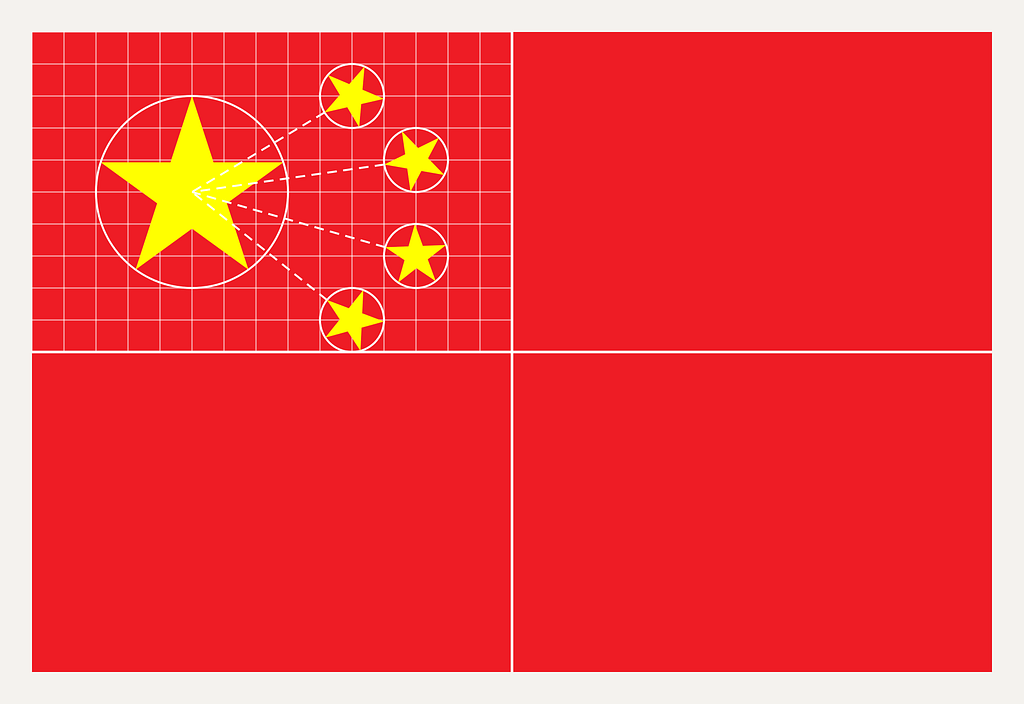
The official construction sheet was published in September 1949, and it is surprisingly precise.
- Divide the flag into four equal quarters.
- Divide the upper-left quarter into a grid of 15 squares across and 10 down.
- The big star sits with its centre 5 squares from the left edge and 5 from the top. It fits in a circle 6 squares wide.
- The small stars each fit in a circle 2 squares wide. Their centres sit at: 10 across and 2 down, 12 across and 4 down, 12 across and 7 down, 10 across and 9 down.
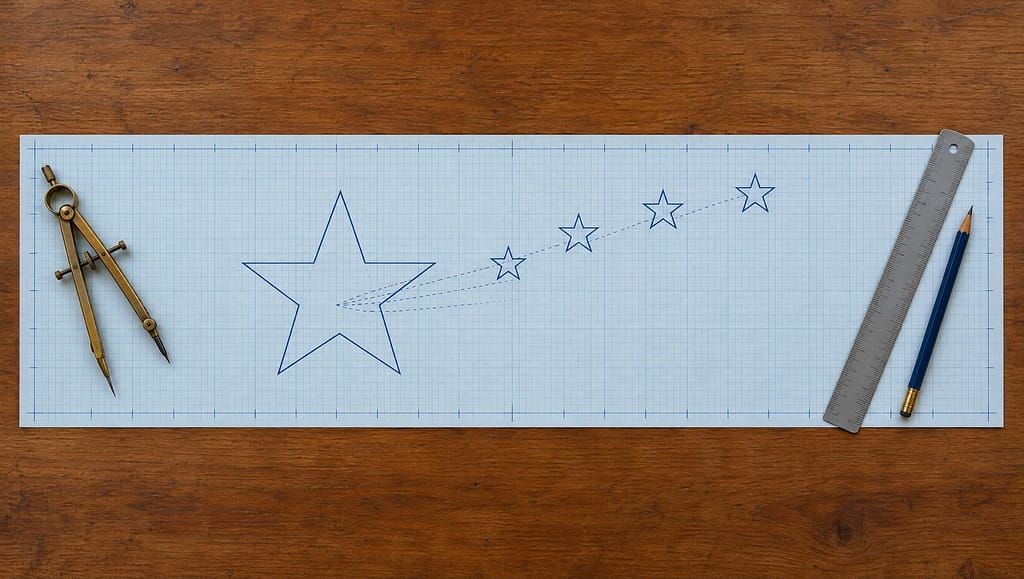
- Each small star is turned so that one of its points aims straight at the centre of the big star.
The detail everyone gets wrong
That last rule, the rotation of the small stars, is the one that trips people up. Even the organisers of the Rio 2016 Olympics got it wrong. Read the full story: wrong stars at the Olympics.
Want to try? Grab a pencil and squared paper: it is a nice exercise. Or pick up our Bandiera della Cina, built on exactly this grid.
Source: Flag of China, Wikipedia.